Let Us Help You
Complete this online form with details of your enquiry and one of our advisors will call you back.
Anyone who reads financial products for a living knows the gap between a quoted rate and a realised return. The quoted figure is an assumption built into the product; the realised one is what actually happened over a given period, and it always comes with a margin of error. The best RTP slots ranking on Slotester applies the same discipline to slot games: it orders tested titles by the realised return from logged sessions on the providers' own official demo servers, sets the declared RTP beside each result, and every row leads to a review page where the game can be tried free in demo.
Put simply, the best RTP slots table is a performance sheet for slot mathematics. Each line shows the declared RTP reported by the server, the measured RTP calculated as total wins over total stakes across every logged run of that game, and an approximate 95% confidence interval. As of 20 October 2026 it covers 163 tests built from 2,820,000 ordinary rounds across 282 separate runs, with 10,200 bonus purchases kept in their own ledger.
Read like a fund factsheet, the table has one rule that outranks all others: a measured return is a record of the past, not a projection. The figures below show why that caution matters.
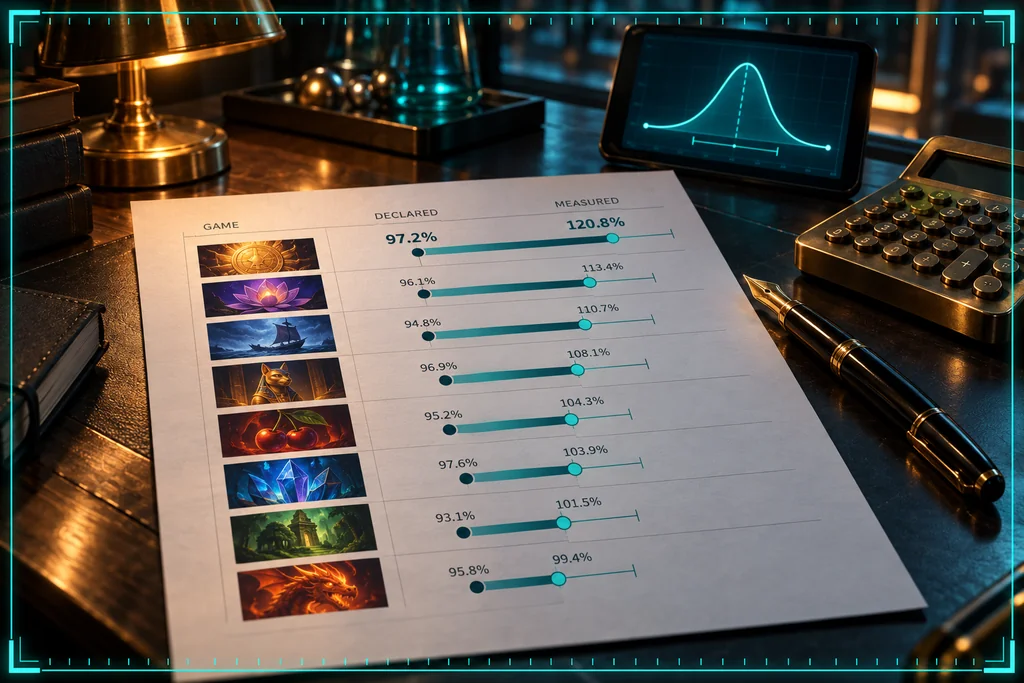
Quoted rate and realised return: the two columns
The declared RTP is the quoted rate. It is the share of all stakes that the maths of a game is designed to pay back over millions of rounds, and the Slotester Lab rig logs the exact return version that the demo server announces for the tested build rather than a number lifted from marketing copy. The measured RTP is the realised return: the sum of every logged win divided by the sum of every logged bet, with naturally triggered features included and bought features kept in a separate ledger.
Comparability comes from method. Every game runs under the same terms: one stake, default settings, the same session length, the official demo build and every server response written to a log. Nothing is simulated on a local machine. The table is sorted by the measured column, highest first, and near-identical results are treated as a statistical tie rather than a judgement about which game is better. One consequence surprises newcomers: the best RTP slots by measurement are often not the ones with the highest quoted rate, because a game printed at 96.1% can out-return one printed several points higher over a single sample.
Why can a measured return above 100% still not mean profit?
A measured RTP above 100% means that one sample of play happened to return more than it took in. It does not turn a slot into an income stream. Every game in the ranking is built with a long-run edge in its own favour, and a result above 100% usually reflects one or two very large rounds that a different session would simply not contain.
The distinction is the familiar one between expected value and variance. The expectation is fixed by the design: across the 163 tests the declared average is 96.38%. Variance decides how far any single sample strays from that anchor, and in slots it is large. The measured average across the lab is 95.9%, equivalent to an edge of about 4.1 bets per 100 staked, and 90 of the 163 tests came in below their declared figure while 73 came in above. Small differences in the quoted rate also matter over time: at the same stake and speed, the hourly cost of a 96% game is roughly half that of a 92% one, because the edge is four points instead of eight.
The top and bottom of the table, set out like a fund sheet
The leading rows on 20 October 2026 show how far a measured return can overshoot its declared rate, and how wide the band around it stays. The final row is added for contrast: the lowest measured result in the lab.
| Rank | Game | Measured RTP | Declared RTP | Approx. 95% band | Spins (runs) | Provider |
|---|---|---|---|---|---|---|
| 1 | Bonanza Trillion | 120.76% | 97.17% | 88.27% to 153.25% | 10,000 (1) | BGaming |
| 2 | Top Dawg$ | 119.17% | 96.10% | 68.14% to 170.20% | 70,000 (7) | Relax Gaming |
| 4 | Folsom Prison | 111.85% | 96.07% | 77.77% to 145.94% | 60,000 (6) | Nolimit City |
| 163 | Wanted Dead or a Wild | 70.53% | 96.38% | 48.70% to 92.36% | 10,000 (1) | Hacksaw Gaming |
Bonanza Trillion, a high-volatility release from 2025, took the top spot from a single 10,000-round run on 8 September 2026; its largest round was 1,225x the stake and a natural bonus arrived about once every 147 rounds. Top Dawg$ has the opposite profile: seven runs between 19 September and 15 October 2026, yet a band still more than 100 points wide. Wanted Dead or a Wild, tested once on 13 October 2026, is one of the few results where the declared figure falls outside the band altogether, the kind of outcome that, by the lab's own standard, calls for a further run rather than a conclusion.
How wide is the confidence band on a single test?
On a single test the band is usually wide, and on volatile games it can be enormous: the broadest band anywhere in the register covers 183.5 percentage points. That width is not a flaw in the measurement. It is an honest statement of how little one session can reveal about a game that pays most of its return in rare bursts.
The band is an approximate 95% confidence interval: the average return per round, widened on each side by 1.96 times its standard error, which is the standard deviation shrunk by the root of the round count. In plain terms, it marks the range in which the long-run return of the tested build plausibly sits, given the sample. It is not a forecast range for the next session, and rare large payouts make the normal approximation imperfect.
The tail is not symmetrical in practice. In the open CSV, each of the ten tests whose declared figure falls outside the band measured below it, Wanted Dead or a Wild among them. That is not evidence of anything untoward; it is the pattern expected when most of a game's return sits in rare rounds that a short sample can miss entirely, and it is precisely why such results are flagged for another run.
For an analyst the useful reading is simple. When the declared RTP sits inside the band, the measurement is consistent with the published maths, which holds for 153 tests out of 163. A measured 120.76% whose band reaches down to 88.27% says the sample was kind, not that the game outperforms its own design.
Does pooling more runs make the estimate trustworthy?
Pooling helps, but it narrows the interval without revealing the truth. When a game is retested, the extra run starts from a new demo session on the identical build, and the headline figures merge every run as though they formed one extended session. The per-run history on the review page still separates them, each with its own return, band, buys and log file.
Folsom Prison illustrates the point: six runs and 60,000 rounds, first published on 3 October 2026 with the latest run on 15 October 2026, and a pooled band from 77.77% to 145.94%. Its 300 logged feature purchases returned 1.16x the price on average, yet 81.7% of individual tickets came back below their cost, a reminder that a mean can be lifted by a handful of large outcomes while most single results disappoint.
Same game, different terms: RTP versions
In finance the same fund can be sold in share classes carrying different charges. Slots work in a similar way. Many studios ship one maths model in several return profiles, the headline figure plus one or two lower variants a couple of points apart, and the game looks identical in every version because only the paytable weights change.
That is why the declared column records the profile reported by the demo server for the tested build. Anyone who later meets the same title elsewhere can compare the figure on its information screen with the declared value in the table; if that copy shows a lower number, the measurements describe a better-priced version than the one on offer.

What can a reader settle with the Slotester ranking at slotester.com?
- Which tested slot has the highest measured RTP? Bonanza Trillion from BGaming, at 120.8% against a declared 97.2% over 10,000 spins.
- Which game sits at the bottom? Wanted Dead or a Wild from Hacksaw Gaming, with 70.5% measured against 96.4% declared.
- Does a larger sample guarantee a narrow band? No: Top Dawg$ logged 70,000 spins over seven runs and its band still runs from 68.14% to 170.20%.
- How does the measured average compare with the declared one? Across all 163 tests it is 95.9% measured against 96.38% declared.
- How often does the declared figure fall within the band? Inside it for 153 tests, outside it for 10.
- How many tests finished above the declared rate? 73, against 90 below.
- Is a bonus purchase worth its price on average? Each game shows a buy value, and Folsom Prison's 300 buys averaged 1.16x the price even though most tickets lost.
- Can the table be ordered by something other than measured RTP? Yes: declared RTP, hit rate, biggest win and bonus value all work as sort keys.
- Is the order adjusted by hand? No, nothing is edited manually and a weak result keeps its place.
- Can the figures be audited? Every run's log is published with a SHA-256 checksum, and its CSV reproduces the value when total wins are divided by total bets.
What the table is useful for beyond the headline number
The measured RTP sorts the table, but it is rarely the most practical column. The best RTP slots table works better as a comparison tool across several dimensions at once:
- Comparing declared RTP across games, using the profile actually reported by the demo server rather than a headline figure.
- Seeing volatility in practice through hit rate, which spans 9% to 43% in the register, and the longest dry run, which reached 114 spins.
- Gauging bonus frequency in bHz, the lab's own unit for naturally triggered features per thousand rounds.
- Checking buy value, the mean return of a purchased feature divided by its price, for the games that sell one.
- Opening the free demo on each game's review page, which opens in the browser, uses virtual credits and asks for no registration, to see how those numbers feel in play.
For the complete picture, Slotester Lab keeps its home page at https://slotester.com/ as the register of all 163 tests: a table of measurements that can be sorted by any column, links to every ranking, and the research on declared versus measured RTP, bonus buys and volatility.

Questions about reading the measured ranking
Why does the order ignore the declared rate?
Because the ranking reports what the logged rounds returned. One run is one sample, and a high-variance title can outscore a calmer one in one series and fall behind it in the next. The band printed on each review shows the size of that room.
Does a return above 100% mean the game is loose?
No. It usually means the sample happened to include a couple of outsized rounds. The declared figure is the long-run target, and across enough games the measured values fall on both sides of it.
How often does the table change?
Every newly published test re-sorts it automatically. Games already listed move only after a re-run, and each re-run is noted in the test history of the review.
Can the measured figure be checked independently?
Yes. Each review links to the spin log of every run with a SHA-256 checksum. Summing the wins and dividing by the summed bets in the CSV gives the published figure, and the methodology page lists the exact command.
Where does the demo on each review page come from?
From the official demo server of the provider, the same source the tests use. It plays in the browser on virtual credits, and anything an operator might add on top, such as limits or promotions, lies outside the test.
Gambling is a cost line, not an asset class
No figure in this table describes an investment. Slots are paid entertainment restricted to adults aged 18 and over, and every game keeps a long-run edge whatever a single sample shows. The free demo attached to each review uses virtual credits only and is the right place to explore a game. Anyone who plays for money should budget for it like any other discretionary spend: agree a spending ceiling and a session length in advance, stop when either is reached, never chase losses, and never read a measured RTP as a promise or gambling as a way to earn.